A love for the game. A place to grow. Free home training hub →
Training hub · Technical

Football drills. Every age.

Ball mastery, dribbling, passing, finishing and small games — each with a diagram, kit list, no-kit swaps and how much to do for your player's age.

Age
Focus

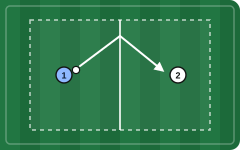
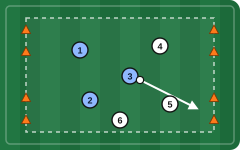
Player Defender Cone Pass Run Dribble Shot
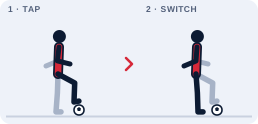
Illustration showing how to do toe taps
Ball mastery

Toe taps

5–89–1112–1415+

The classic warm-up touch. Builds rhythm, balance and soft feet.

5 minSolo
Equipment
  • Football Any ball works. Size 3 for 5–8s, size 4 for 9–14s, size 5 for 15+. Indoors, a soft ball or rolled-up pair of socks
How to do it

Steps

  1. Stand behind the ball with feet hip-width apart.
  2. Lightly tap the top of the ball with the sole of one foot, then the other, with a small hop between taps.
  3. Stay on the balls of your feet and keep the ball still.
  4. Count your taps in each round and try to beat your score.

Coaching points

  • Touch the ball, don't stamp on it.
  • Eyes up between taps as you get better.
  • Arms relaxed and moving like you are jogging.

How much, by age

  • 5–84 × 20 s, rest 20 s
  • 9–114 × 30 s
  • 12–145 × 30 s, add moving forwards and back
  • 15+6 × 40 s with circles around the ball
EasierGo slowly and hold a wall or chair for balance.
HarderMove in a circle around the ball, or respond to a parent calling 'left', 'right' or 'switch'.
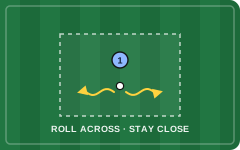
Illustration showing how to do sole rolls
Ball mastery

Sole rolls

5–89–1112–14

Roll the ball across your body with the sole to build close control.

5 minSolo
Equipment
  • Football Any ball works. Size 3 for 5–8s, size 4 for 9–14s, size 5 for 15+. Indoors, a soft ball or rolled-up pair of socks
How to do it

Steps

  1. Put the sole of your right foot on top of the ball.
  2. Roll it across your body to the left, then let it meet the inside of your left foot.
  3. Put your left sole on top and roll it back to the right.
  4. Keep a little hop on your standing foot to stay balanced.

Coaching points

  • Roll the ball, don't drag it.
  • Keep the ball close – no further than one step away.
  • Bend your standing knee slightly.

How much, by age

  • 5–83 × 20 s each way
  • 9–114 × 30 s
  • 12–144 × 30 s, then add a pull-back at the end of each roll
EasierRoll with one foot only, stopping between each roll.
HarderRoll the ball while moving sideways across a space, or add a quick pull-back and push.
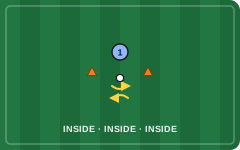
Illustration showing how to do tic-tocs (inside–inside)
Ball mastery

Tic-tocs (inside–inside)

5–89–1112–1415+

Fast little touches between the insides of both feet. The engine of good dribbling.

5 minSolo
Equipment
  • Football Any ball works. Size 3 for 5–8s, size 4 for 9–14s, size 5 for 15+. Indoors, a soft ball or rolled-up pair of socks
  • Cones or markers Shoes, water bottles, tins, plastic cups, rolled-up socks or T-shirts
How to do it

Steps

  1. Stand with the ball between your feet.
  2. Pass the ball from the inside of one foot to the inside of the other, with small quick touches.
  3. Stay on your toes and keep your knees soft.
  4. Once comfortable, move slowly forward, then backwards, while doing tic-tocs.

Coaching points

  • Small touches – the ball should barely leave your feet.
  • Head up as often as you can.
  • Speed comes last: get it clean first.

How much, by age

  • 5–84 × 20 s
  • 9–114 × 30 s
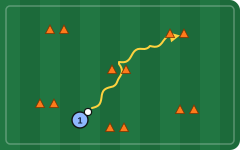
  • 12–145 × 30 s moving through a gate
  • 15+6 × 30 s, finishing with a burst of speed
EasierUse slower touches and stop the ball between each one.
HarderMove between two markers while doing tic-tocs, then accelerate away.
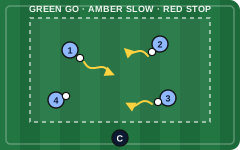
Illustration showing how to do traffic lights
Dribbling game

Traffic lights

5–8

A fun dribbling game for younger players. Listen, react and keep the ball close.

10 minGroup or parent + child
Equipment
  • Football Any ball works. Size 3 for 5–8s, size 4 for 9–14s, size 5 for 15+. Indoors, a soft ball or rolled-up pair of socks
  • Cones or markers Shoes, water bottles, tins, plastic cups, rolled-up socks or T-shirts
How to do it

Steps

  1. Mark out a square about 10 big steps wide.
  2. Every player dribbles a ball inside the square.
  3. The caller shouts a colour: GREEN = dribble fast, AMBER = slow dribble, RED = stop the ball with your sole.
  4. Add fun extras: 'Roundabout' = dribble in a circle, 'Speed bump' = jump over your ball.

Coaching points

  • Little touches so you can stop quickly.
  • Look up for space and other players.
  • Stop the ball with your sole, not your hands.

How much, by age

  • 5–83 rounds of 2–3 min with water breaks
EasierUse a bigger square and fewer colours.
HarderUse the weaker foot only on 'amber'.
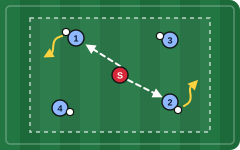
Illustration showing how to do shark attack
Dribbling game

Shark attack

5–89–11

Minnows dribble, the shark hunts. Protects the ball and builds decision-making.

10 minGroup of 4+
Equipment
  • Football Any ball works. Size 3 for 5–8s, size 4 for 9–14s, size 5 for 15+. Indoors, a soft ball or rolled-up pair of socks
  • Cones or markers Shoes, water bottles, tins, plastic cups, rolled-up socks or T-shirts
  • Bibs Different coloured T-shirts
How to do it

Steps

  1. Mark out a square. All players (minnows) have a ball, except one or two sharks.
  2. Minnows dribble around the square trying to keep their ball.
  3. Sharks try to kick balls out of the square.
  4. If your ball is kicked out, you become a shark. Last minnow wins.

Coaching points

  • Keep your body between the shark and the ball.
  • Use changes of direction to escape.
  • Sharks: stay low and be patient.

How much, by age

  • 5–84 rounds of 2 min
  • 9–115 rounds of 2 min, square slightly smaller each round
EasierMake the square bigger and start with one shark.
HarderMinnows can only use their weaker foot, or add a 'safe zone' they can visit for 3 seconds only.
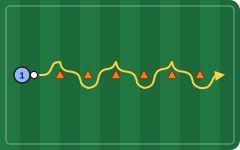
Illustration showing how to do slalom dribble
Dribbling

Slalom dribble

5–89–1112–14

Weave in and out of a line of markers using both feet.

10 minSolo
Equipment
  • Football Any ball works. Size 3 for 5–8s, size 4 for 9–14s, size 5 for 15+. Indoors, a soft ball or rolled-up pair of socks
  • Cones or markers Shoes, water bottles, tins, plastic cups, rolled-up socks or T-shirts
How to do it

Steps

  1. Put 6 markers in a straight line, about 1–2 big steps apart.
  2. Dribble in and out of every marker to the end.
  3. Turn and come back through the line.
  4. Try different parts of the foot: inside only, outside only, then both.

Coaching points

  • Small touches near the markers, bigger touches in open space.
  • Use the foot furthest from the marker.
  • Look up at the end of the line.

How much, by age

  • 5–84 runs each way
  • 9–116 runs, alternating inside and outside
  • 12–148 runs, timed, closer markers
EasierSpread the markers further apart.
HarderTime yourself, use the weaker foot only, or bring the markers closer.
Illustration showing how to do gate challenge
Dribbling

Gate challenge

5–89–11

Dribble through as many 'gates' as you can in 60 seconds. Head up, find space.

10 minSolo or group
Equipment
  • Football Any ball works. Size 3 for 5–8s, size 4 for 9–14s, size 5 for 15+. Indoors, a soft ball or rolled-up pair of socks
  • Cones or markers Shoes, water bottles, tins, plastic cups, rolled-up socks or T-shirts
How to do it

Steps

  1. Make 6–8 gates (two markers, one step apart) spread around a space.
  2. Start the timer and dribble through as many different gates as you can.
  3. You can't go through the same gate twice in a row.
  4. Count your gates. Try to beat your score in the next round.

Coaching points

  • Head up to spot the next free gate.
  • Keep the ball close as you go through.
  • Speed up between gates.

How much, by age

  • 5–84 × 60 s
  • 9–115 × 60 s, weaker foot in round 5
EasierMake the gates wider.
HarderMust turn after every gate, or a parent stands in a gate to 'close' it.
Illustration showing how to do body-part stop
Dribbling game

Body-part stop

5–8

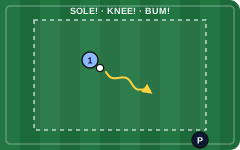
Dribble around, then stop the ball with the body part called out. Laughs guaranteed.

10 minParent + child
Equipment
  • Football Any ball works. Size 3 for 5–8s, size 4 for 9–14s, size 5 for 15+. Indoors, a soft ball or rolled-up pair of socks
How to do it

Steps

  1. Dribble freely around a space.
  2. The parent calls a body part: 'Sole!', 'Knee!', 'Bum!', 'Elbow!', 'Head!' (hand on the ball for 'head' – no heading).
  3. Stop the ball and touch it with that body part as quickly as possible.
  4. Then dribble off again.

Coaching points

  • Keep the ball close so you can stop it quickly.
  • Change direction after each stop.

How much, by age

  • 5–83 × 3 min
EasierOnly use 'sole' and 'knee'.
HarderAdd a turn after each stop.
Illustration showing how to do skittles passing
Passing

Skittles passing

5–89–11

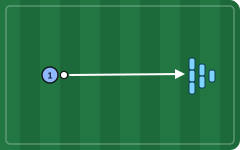
Knock down 'skittles' with accurate side-foot passes.

10 minSolo or pairs
Equipment
  • Football Any ball works. Size 3 for 5–8s, size 4 for 9–14s, size 5 for 15+. Indoors, a soft ball or rolled-up pair of socks
  • Targets Empty plastic bottles, cans or cups to knock over
How to do it

Steps

  1. Stand 5–8 big steps from a group of plastic bottles.
  2. Pass with the inside of the foot to knock them down.
  3. Set them up again and move back a step when you score 3 in a row.
  4. Play against a partner: first to knock all the skittles down wins.

Coaching points

  • Non-kicking foot next to the ball, pointing at the target.
  • Strike through the middle of the ball with the inside of the foot.
  • Follow through towards the target.

How much, by age

  • 5–820 passes, 10 each foot
  • 9–1130 passes, alternate feet, move back each round
EasierMove closer and use a bigger target.
HarderUse a first touch to control a pass from a partner before passing at the skittles.
Illustration showing how to do wall passes & first touch
Passing

Wall passes & first touch

9–1112–1415+

Pass against a wall and control the rebound. The best solo passing drill there is.

10 minSolo
Equipment
  • Football Any ball works. Size 3 for 5–8s, size 4 for 9–14s, size 5 for 15+. Indoors, a soft ball or rolled-up pair of socks
  • Wall or rebounder A safe brick wall you have permission to use, a garage door, a low step or kerb, or a partner
  • Cones or markers Shoes, water bottles, tins, plastic cups, rolled-up socks or T-shirts
How to do it

Steps

  1. Stand 3–5 big steps from a wall.
  2. Pass with the inside of your right foot, control the rebound with your left, then pass with your left.
  3. Next, control the ball across your body into space before passing again.
  4. Finish with one-touch passes for 30 seconds.

Coaching points

  • First touch out of your feet, into space.
  • Strike the middle of the ball so it stays on the ground.
  • Be on your toes before the ball arrives.

How much, by age

  • 9–114 × 1 min
  • 12–145 × 1 min, mixing two-touch and one-touch
  • 15+6 × 1 min, add a marker to step around after each touch
EasierStand closer and stop the ball each time.
HarderUse only one touch, or step further back and use a firmer pass.
Illustration showing how to do partner gate passing
Passing

Partner gate passing

9–1112–14

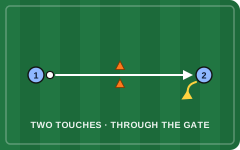
Pass through a small gate to a partner. Accuracy plus a clean two-touch.

10 minPairs
Equipment
  • Football Any ball works. Size 3 for 5–8s, size 4 for 9–14s, size 5 for 15+. Indoors, a soft ball or rolled-up pair of socks
  • Cones or markers Shoes, water bottles, tins, plastic cups, rolled-up socks or T-shirts
How to do it

Steps

  1. Set up a gate (two markers, one step apart) halfway between two players about 10 steps apart.
  2. Pass through the gate to your partner.
  3. Partner controls across their body with one touch and passes back with the second.
  4. Score a point for every pass through the gate.

Coaching points

  • Open your body to receive.
  • Pass with pace – not too soft.
  • Talk: call for the ball.

How much, by age

  • 9–114 × 1 min
  • 12–145 × 1 min, then one-touch round
EasierMake the gate wider.
HarderMake the gate narrower and move the players further apart.
Illustration showing how to do turning box
Turns

Turning box

9–1112–1415+

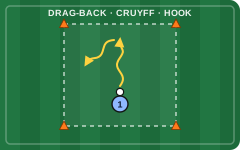
Practise the turns that get you out of trouble: drag-back, Cruyff and inside hook.

10 minSolo
Equipment
  • Football Any ball works. Size 3 for 5–8s, size 4 for 9–14s, size 5 for 15+. Indoors, a soft ball or rolled-up pair of socks
  • Cones or markers Shoes, water bottles, tins, plastic cups, rolled-up socks or T-shirts
How to do it

Steps

  1. Mark out a box about 10 steps square.
  2. Dribble towards one side of the box.
  3. Just before the line, turn: drag-back (sole pulls ball back), Cruyff (inside of foot behind standing leg) or inside hook.
  4. Accelerate away towards another side and repeat with a different turn.

Coaching points

  • Sell it: look like you are going to pass or shoot before turning.
  • Get low as you turn.
  • Explode away after the turn – the burst matters most.

How much, by age

  • 9–113 × 2 min, one turn per round
  • 12–144 × 2 min, mixing turns
  • 15+5 × 90 s at match speed
EasierPractise each turn slowly while standing still first.
HarderA partner acts as a defender on the line.
Illustration showing how to do juggling ladder
Ball mastery

Juggling ladder

5–89–1112–1415+

Keepy-uppies, built up step by step. Great for touch and confidence.

10 minSolo
Equipment
  • Football Any ball works. Size 3 for 5–8s, size 4 for 9–14s, size 5 for 15+. Indoors, a soft ball or rolled-up pair of socks
How to do it

Steps

  1. Level 1: drop the ball, let it bounce, kick it up and catch it.
  2. Level 2: kick, bounce, kick – let it bounce between each touch.
  3. Level 3: two touches in the air, then catch.
  4. Level 4: keep it up using feet and thighs, then try both feet.

Coaching points

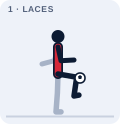
  • Lock your ankle and use the laces, toes pointed slightly up.
  • Small, soft kicks – waist height is plenty.
  • Heading is not part of juggling for younger players.

How much, by age

  • 5–85 min on levels 1–2
  • 9–118 min, record your best score
  • 12–1410 min, alternate feet
  • 15+10 min, add thigh–foot–thigh patterns
EasierUse a lighter or slightly deflated ball, or a balloon indoors.
HarderJuggle while walking forwards, or alternate feet every touch.
Illustration showing how to do change-of-pace dribble
Dribbling

Change-of-pace dribble

9–1112–1415+

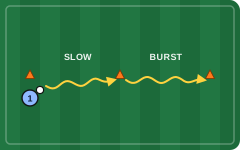
Slow, slow… BURST. Learn to beat players with a change of speed.

10 minSolo
Equipment
  • Football Any ball works. Size 3 for 5–8s, size 4 for 9–14s, size 5 for 15+. Indoors, a soft ball or rolled-up pair of socks
  • Cones or markers Shoes, water bottles, tins, plastic cups, rolled-up socks or T-shirts
How to do it

Steps

  1. Set three markers in a line, about 10 steps between each.
  2. Dribble slowly with close control to the middle marker.
  3. At the middle marker, push the ball further ahead and sprint to the end.
  4. Jog back and repeat, using the other foot.

Coaching points

  • Slow part: tiny touches, eyes up.
  • Fast part: bigger touches with the laces, every 2–3 steps.
  • Lean forward when you accelerate.

How much, by age

  • 9–116 runs
  • 12–148 runs
  • 15+8–10 runs, add a fake before the burst
EasierWalk the slow part.
HarderA partner chases from 2 steps behind once you reach the middle marker.
Illustration showing how to do safe-side dribbling
1v1 attacking

Safe-side dribbling

9–1112–1415+

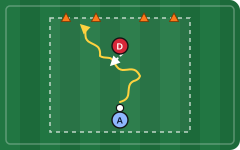
Keep the ball on the side away from the defender. A favourite in our sessions.

10 minPairs
Equipment
  • Football Any ball works. Size 3 for 5–8s, size 4 for 9–14s, size 5 for 15+. Indoors, a soft ball or rolled-up pair of socks
  • Cones or markers Shoes, water bottles, tins, plastic cups, rolled-up socks or T-shirts
How to do it

Steps

  1. A partner walks or jogs alongside you as a passive defender.
  2. Dribble with the foot furthest from them, keeping your body between them and the ball.
  3. When they switch sides, switch the ball to your other foot.
  4. Progress to a light, then full-pressure defender.

Coaching points

  • Arm out (gently) to feel where the defender is.
  • Use the outside of the foot to keep the ball away.
  • Shoulders low and strong.

How much, by age

  • 9–114 × 45 s
  • 12–145 × 45 s
  • 15+6 × 45 s, defender at full pressure
EasierThe defender walks and only shadows.
HarderFinish by dribbling through a gate or shooting at a goal.
Illustration showing how to do 1v1 to the end line
1v1 attacking

1v1 to the end line

9–1112–1415+

Beat your opponent and dribble through either end-line gate.

15 minPairs
Equipment
  • Football Any ball works. Size 3 for 5–8s, size 4 for 9–14s, size 5 for 15+. Indoors, a soft ball or rolled-up pair of socks
  • Cones or markers Shoes, water bottles, tins, plastic cups, rolled-up socks or T-shirts
How to do it

Steps

  1. Mark a channel about 10 steps wide and 15 steps long with two gates at the far end.
  2. The defender passes the ball to the attacker and steps in to defend.
  3. The attacker scores by dribbling through either gate.
  4. Swap roles every go.

Coaching points

  • Attack at speed and get the defender to commit.
  • Use a fake, then a change of direction and pace.
  • Defender: side-on, low and patient.

How much, by age

  • 9–118–10 goes each
  • 12–1410 goes each
  • 15+12 goes each, 6-second limit to score
EasierMake the channel wider.
HarderAdd a time limit or a small goal for the defender to counter into.
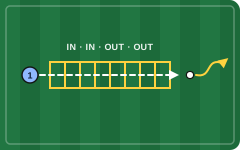
Illustration showing how to do footwork ladder + ball
Footwork & agility

Footwork ladder + ball

5–89–1112–1415+

Quick feet through the ladder, then straight onto the ball. From our footwork sessions.

10 minSolo
Equipment
  • Agility ladder Chalk lines on the ground, tape on a hard floor, or sticks laid in a row
  • Football Any ball works. Size 3 for 5–8s, size 4 for 9–14s, size 5 for 15+. Indoors, a soft ball or rolled-up pair of socks
How to do it

Steps

  1. Run through the ladder with one foot in each square.
  2. Then two feet in each square, then 'in-in-out-out' sideways.
  3. Coming out of the ladder, take a touch on the ball and dribble away fast.
  4. Walk back to the start to recover.

Coaching points

  • Quick, light feet – stay on your toes.
  • Arms working.
  • Eyes up as you come out of the ladder.

How much, by age

  • 5–86 runs, one foot per square
  • 9–118 runs, 3 patterns
  • 12–1410 runs, 4 patterns
  • 15+10–12 runs, finish with a shot
EasierWalk through first to learn the pattern.
HarderPartner passes the ball as you exit, and you take it first time.
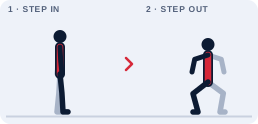
Illustration showing how to do four-square footwork
Footwork & agility

Four-square footwork

5–89–1112–14

Fast feet around a small square, then a touch on the ball. As seen in our training reels.

10 minSolo
Equipment
  • Small square Four shoes, tape or chalk making a square about one foot wide
  • Football Any ball works. Size 3 for 5–8s, size 4 for 9–14s, size 5 for 15+. Indoors, a soft ball or rolled-up pair of socks
How to do it

Steps

  1. Stand beside the square.
  2. Step in with both feet, then out to the other side, as fast as you can.
  3. Try hopping in and out, then go around all four sides.
  4. Finish each set with 10 toe taps on the ball.

Coaching points

  • Little steps.
  • Land softly and quietly.
  • Stay tall with the head up.

How much, by age

  • 5–84 × 15 s
  • 9–115 × 20 s
  • 12–146 × 20 s, add single-leg hops
EasierWalk the pattern.
HarderA parent calls out which side to jump to.
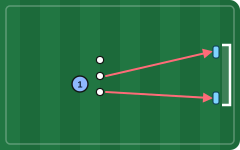
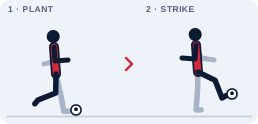
Illustration showing how to do laces strike at targets
Shooting

Laces strike at targets

9–1112–1415+

Hit clean, powerful shots into the corners.

15 minSolo or pairs
Equipment
  • Football Any ball works. Size 3 for 5–8s, size 4 for 9–14s, size 5 for 15+. Indoors, a soft ball or rolled-up pair of socks
  • Goal Two bags or jumpers as posts, a chalk square on a safe wall, or a bin to hit
  • Cones or markers Shoes, water bottles, tins, plastic cups, rolled-up socks or T-shirts
How to do it

Steps

  1. Put a target in each corner of the goal (a bottle, bag or chalk mark).
  2. Place balls about 10–12 steps away.
  3. Approach at a slight angle, plant your standing foot next to the ball, strike with your laces.
  4. Aim low into the corners. Score 3 points for a target, 1 for a goal.

Coaching points

  • Toes pointed down, ankle locked.
  • Body over the ball to keep it low.
  • Land on your kicking foot after the strike.

How much, by age

  • 9–1115 shots, both feet
  • 12–1420 shots, both feet
  • 15+20–25 shots, a mix of side-foot and laces
EasierStart closer, side-foot finish.
HarderTake a touch out of your feet first, then shoot within 2 seconds.
Illustration showing how to do dribble & finish
Shooting

Dribble & finish

9–1112–1415+

Beat the markers, then finish. The 'finishing phase' from our sessions.

15 minSolo
Equipment
  • Football Any ball works. Size 3 for 5–8s, size 4 for 9–14s, size 5 for 15+. Indoors, a soft ball or rolled-up pair of socks
  • Goal Two bags or jumpers as posts, a chalk square on a safe wall, or a bin to hit
  • Cones or markers Shoes, water bottles, tins, plastic cups, rolled-up socks or T-shirts
How to do it

Steps

  1. Set 3 markers in a line facing the goal.
  2. Dribble through them quickly.
  3. After the last marker, take a touch to set yourself and shoot.
  4. Alternate which foot you finish with.

Coaching points

  • Look up at the goal before you shoot.
  • Pick a corner early.
  • Shoot across the goalkeeper.

How much, by age

  • 9–1110 runs
  • 12–1412 runs
  • 15+12–15 runs, finish in 1 touch after the last marker
EasierRemove the markers and just dribble and shoot.
HarderAdd a chasing defender from behind.
Illustration showing how to do first-time finishing
Shooting

First-time finishing

12–1415+

Finish a pass first time. Sharp feet, quick decisions.

15 minPairs
Equipment
  • Football Any ball works. Size 3 for 5–8s, size 4 for 9–14s, size 5 for 15+. Indoors, a soft ball or rolled-up pair of socks
  • Goal Two bags or jumpers as posts, a chalk square on a safe wall, or a bin to hit
How to do it

Steps

  1. A partner stands to the side and plays passes across the box.
  2. Make a run onto the pass and finish first time.
  3. Vary the pass: along the ground, bouncing, from different angles.
  4. Swap roles after 10 finishes.

Coaching points

  • Adjust your feet early so you strike in your stride.
  • Side-foot for accuracy, laces for power.
  • Stay calm – placement beats power.

How much, by age

  • 12–142 × 10 finishes
  • 15+3 × 10 finishes
EasierAllow one touch to control first.
HarderPartner plays the pass then becomes a defender.
Illustration showing how to do weaker-foot week
Passing

Weaker-foot week

5–89–1112–1415+

A week of using only your weaker foot. The fastest way to become two-footed.

10 minSolo
Equipment
  • Football Any ball works. Size 3 for 5–8s, size 4 for 9–14s, size 5 for 15+. Indoors, a soft ball or rolled-up pair of socks
  • Wall or rebounder A safe brick wall you have permission to use, a garage door, a low step or kerb, or a partner
How to do it

Steps

  1. For one week, every touch in home practice uses your weaker foot.
  2. Start with wall passes from close range.
  3. Add dribbling and toe taps with the weaker foot only.
  4. End each day by counting 20 clean passes in a row.

Coaching points

  • Plant foot points at the target.
  • Be patient – it will feel awkward at first.
  • Little and often beats long sessions.

How much, by age

  • 5–85 min a day
  • 9–1110 min a day
  • 12–1410–15 min a day
  • 15+15 min a day
EasierMix weaker and stronger foot 50/50.
HarderShoot and cross with the weaker foot too.
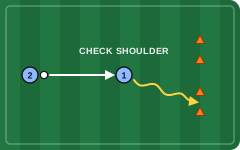
Illustration showing how to do receiving on the half-turn
Passing

Receiving on the half-turn

9–1112–1415+

Check your shoulder, open your body and turn with your first touch.

15 minPairs
Equipment
  • Football Any ball works. Size 3 for 5–8s, size 4 for 9–14s, size 5 for 15+. Indoors, a soft ball or rolled-up pair of socks
  • Cones or markers Shoes, water bottles, tins, plastic cups, rolled-up socks or T-shirts
How to do it

Steps

  1. A partner passes to you from 10–15 steps away. Two gates are set up behind you.
  2. Before the ball arrives, look over your shoulder to see which gate is free.
  3. Open your body side-on and receive across you with the back foot.
  4. Dribble out through a gate. The partner can point to the 'closed' gate.

Coaching points

  • Scan early: look before the ball is passed.
  • Side-on body shape, not square.
  • First touch forwards, not under your feet.

How much, by age

  • 9–1110 receptions
  • 12–1415 receptions
  • 15+20 receptions, partner then pressures
EasierPartner shouts which gate is free.
HarderA third player defends one of the gates.
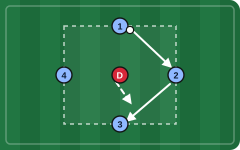
Illustration showing how to do rondo 4v1
Possession

Rondo 4v1

9–1112–1415+

Keep-ball in a small square. Quick passing, angles and teamwork.

15 minGroup of 5
Equipment
  • Football Any ball works. Size 3 for 5–8s, size 4 for 9–14s, size 5 for 15+. Indoors, a soft ball or rolled-up pair of socks
  • Cones or markers Shoes, water bottles, tins, plastic cups, rolled-up socks or T-shirts
  • Bibs Different coloured T-shirts
How to do it

Steps

  1. Mark a square about 8–10 steps wide.
  2. Four players on the outside keep the ball from one defender in the middle.
  3. If the defender wins the ball or it leaves the square, the player who lost it goes in.
  4. Count passes: 10 in a row is a point.

Coaching points

  • Move to make an angle for the player on the ball.
  • Pass to the foot away from the defender.
  • Two touches max, then one touch.

How much, by age

  • 9–114 × 2 min
  • 12–145 × 2 min, two touches
  • 15+6 × 90 s, one touch, or 5v2
EasierMake the square bigger or allow three touches.
HarderPlay 5v2 or limit to one touch.
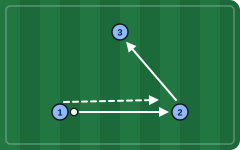
Illustration showing how to do pass and follow triangle
Passing

Pass and follow triangle

9–1112–1415+

Pass, then follow your pass to the next cone. Builds rhythm and movement.

10 minGroup of 3+
Equipment
  • Football Any ball works. Size 3 for 5–8s, size 4 for 9–14s, size 5 for 15+. Indoors, a soft ball or rolled-up pair of socks
  • Cones or markers Shoes, water bottles, tins, plastic cups, rolled-up socks or T-shirts
How to do it

Steps

  1. Set up three markers in a triangle, 8–10 steps apart, with a player at each.
  2. Pass to the next player and follow your pass to their marker.
  3. Receive on the back foot and play on with your second touch.
  4. Change direction every minute.

Coaching points

  • Pass and move – never stand still.
  • Open body to receive.
  • Weight of pass: firm but friendly.

How much, by age

  • 9–114 × 1 min
  • 12–145 × 1 min
  • 15+6 × 1 min, one touch in the last round
EasierAllow extra touches.
HarderOne touch, or add a second ball.
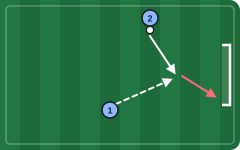
Illustration showing how to do 2v1 overload
Attacking play

2v1 overload

9–1112–1415+

Two attackers versus one defender. When do you pass, when do you dribble?

15 minGroup of 3
Equipment
  • Football Any ball works. Size 3 for 5–8s, size 4 for 9–14s, size 5 for 15+. Indoors, a soft ball or rolled-up pair of socks
  • Goal Two bags or jumpers as posts, a chalk square on a safe wall, or a bin to hit
  • Cones or markers Shoes, water bottles, tins, plastic cups, rolled-up socks or T-shirts
  • Bibs Different coloured T-shirts
How to do it

Steps

  1. Two attackers start at one end; one defender starts near the goal.
  2. Attackers try to score; the defender tries to win the ball.
  3. If the defender comes to you, pass. If they stay with your partner, dribble and shoot.
  4. Rotate roles after every attack.

Coaching points

  • Make the defender commit before passing.
  • Support player: stay wide and level.
  • Finish the move quickly.

How much, by age

  • 9–1110 attacks
  • 12–1412 attacks
  • 15+12 attacks with an 8-second limit
EasierDefender is passive for the first few attacks.
HarderMake it 3v2, or a second defender recovers from behind.
Illustration showing how to do jockeying (1v1 defending)
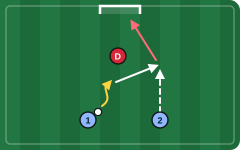
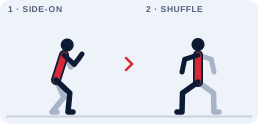
Defending

Jockeying (1v1 defending)

9–1112–1415+

Defend like a pro: side-on, low and patient. Show the attacker where you want them to go.

10 minPairs
Equipment
  • Football Any ball works. Size 3 for 5–8s, size 4 for 9–14s, size 5 for 15+. Indoors, a soft ball or rolled-up pair of socks
  • Cones or markers Shoes, water bottles, tins, plastic cups, rolled-up socks or T-shirts
How to do it

Steps

  1. The attacker dribbles slowly towards you inside a channel.
  2. Stand side-on, knees bent, about one step away.
  3. Move backwards with small shuffles, showing them onto their weaker side.
  4. Only tackle when the ball is away from their feet.

Coaching points

  • Don't dive in.
  • Watch the ball, not the attacker's feet tricks.
  • Stay on your toes.

How much, by age

  • 9–116 × 20 s each
  • 12–148 × 20 s
  • 15+8 × 30 s at full pressure
EasierThe attacker walks.
HarderThe attacker can score in either of two gates.
Illustration showing how to do crossing & finishing
Attacking play

Crossing & finishing

12–1415+

Wide player crosses, striker attacks the space.

15 minGroup of 2–4
Equipment
  • Football Any ball works. Size 3 for 5–8s, size 4 for 9–14s, size 5 for 15+. Indoors, a soft ball or rolled-up pair of socks
  • Goal Two bags or jumpers as posts, a chalk square on a safe wall, or a bin to hit
  • Cones or markers Shoes, water bottles, tins, plastic cups, rolled-up socks or T-shirts
How to do it

Steps

  1. A wide player dribbles down the side and crosses into the box.
  2. The striker times a run to the near post or the far post.
  3. Finish first time where possible.
  4. Swap roles and sides.

Coaching points

  • Crosser: look up before crossing and aim for space, not the player.
  • Striker: start your run late and attack the ball.
  • Cut-backs are often the best ball.

How much, by age

  • 12–1412 crosses each side
  • 15+15 crosses each side
EasierCross from a standing ball.
HarderAdd a defender in the box.
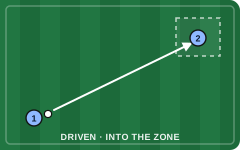
Illustration showing how to do driven long pass
Passing

Driven long pass

12–1415+

Switch play with a driven pass into a target zone.

15 minPairs
Equipment
  • Football Any ball works. Size 3 for 5–8s, size 4 for 9–14s, size 5 for 15+. Indoors, a soft ball or rolled-up pair of socks
  • Cones or markers Shoes, water bottles, tins, plastic cups, rolled-up socks or T-shirts
How to do it

Steps

  1. Mark a target zone about 5 steps square.
  2. Stand 20–30 steps away with a ball.
  3. Approach at an angle, strike through the bottom-middle of the ball with your laces.
  4. Partner must control the ball inside the zone. Swap after 10.

Coaching points

  • Lean back slightly to lift it, lean over it to keep it low and driven.
  • Lock your ankle.
  • Follow through towards the target.

How much, by age

  • 12–142 × 10 passes
  • 15+3 × 10 passes, both feet
EasierShorten the distance.
HarderReceiver must take the ball out of the air with one touch.
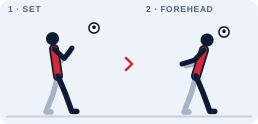
Illustration showing how to do heading technique (low volume)
Heading

Heading technique (low volume)

12–1415+

Learn safe technique with very few repetitions. Follow The FA's current heading guidance.

5 minPairs
Equipment
  • Light ball A softer or slightly deflated ball, or a balloon to learn the movement
How to do it

Steps

  1. Partner gently throws the ball from close range.
  2. Feet set, knees bent, eyes on the ball, mouth closed.
  3. Move your upper body forwards and meet the ball with your forehead.
  4. Keep repetitions very low – quality over quantity.

Coaching points

  • Forehead, not the top of the head.
  • Neck firm, power from the body.
  • Stop if you feel any headache or dizziness and tell an adult.

How much, by age

  • 12–14Very few gentle reps, only where The FA's current guidance allows
  • 15+Low reps, following The FA's current guidance
EasierPractise the body movement without a ball.

Safety: The FA restricts heading practice for young players. Check the latest guidance before practising heading at any age.

Illustration showing how to do goalkeeper ready & catch
Goalkeeping

Goalkeeper ready & catch

5–89–1112–1415+

Ready position and safe catching. Every player benefits from good hands.

10 minPairs
Equipment
  • Football Any ball works. Size 3 for 5–8s, size 4 for 9–14s, size 5 for 15+. Indoors, a soft ball or rolled-up pair of socks
  • Goal Two bags or jumpers as posts, a chalk square on a safe wall, or a bin to hit
How to do it

Steps

  1. Stand in the ready position: feet shoulder-width, knees bent, weight forward, hands in front.
  2. Partner throws or gently kicks the ball at chest height.
  3. Catch with a 'W' shape – thumbs nearly touching behind the ball.
  4. Bring the ball into your chest. Then try low balls with a 'basket' scoop.

Coaching points

  • Watch the ball into your hands.
  • Get your body behind the ball.
  • Soft hands – give with the ball.

How much, by age

  • 5–820 easy throws
  • 9–1130 catches, high and low
  • 12–1440 catches, add side-steps
  • 15+40–50 catches with shots
EasierUse a soft ball and throw underarm.
HarderPartner volleys from further away, or shoots at the corners.
Illustration showing how to do foot tennis
Touch & control

Foot tennis

9–1112–1415+

Volley the ball over a low 'net'. One bounce allowed. Brilliant for first touch.

15 minPairs or 2v2
Equipment
  • Football Any ball works. Size 3 for 5–8s, size 4 for 9–14s, size 5 for 15+. Indoors, a soft ball or rolled-up pair of socks
  • Net A line of shoes, a rope on the ground, a bench, or a row of bags
How to do it

Steps

  1. Set a low 'net' across the middle of a small court.
  2. Serve with a drop-kick over the net.
  3. The ball can bounce once on your side; use up to three touches to return it.
  4. Play to 11 points.

Coaching points

  • Cushion the ball on your first touch.
  • Use thighs and chest to control.
  • Aim for space on the other side.

How much, by age

  • 9–11Games to 7, two bounces allowed
  • 12–14Games to 11
  • 15+Games to 11, one bounce, two touches
EasierAllow two bounces and catching on the serve.
HarderOne touch to return, no bounces.
Illustration showing how to do 3v3 four-goal game
Game

3v3 four-goal game

5–89–1112–1415+

Small-sided game with two goals each. Loads of touches, switching play and fun.

20 minGroup of 6
Equipment
  • Football Any ball works. Size 3 for 5–8s, size 4 for 9–14s, size 5 for 15+. Indoors, a soft ball or rolled-up pair of socks
  • Cones or markers Shoes, water bottles, tins, plastic cups, rolled-up socks or T-shirts
  • Bibs Different coloured T-shirts
How to do it

Steps

  1. Mark a pitch about 20 × 15 steps with two small goals at each end.
  2. Play 3v3. Each team attacks two goals and defends two.
  3. Score by dribbling or passing through a goal.
  4. Rotate teams every 4 minutes.

Coaching points

  • Look for the goal the other team isn't defending.
  • Switch the play quickly.
  • Everyone attacks, everyone defends.

How much, by age

  • 5–84 × 3 min
  • 9–114 × 4 min
  • 12–145 × 4 min
  • 15+6 × 4 min
EasierBigger goals or 4v4.
HarderTwo-touch limit or goals only count after 3 passes.
Want a plan for your player?

Get personal guidance.

Tell us your player's age and goals and we'll point you to the right sessions.