A love for the game. A place to grow. Free home training hub →
Training hub · Conditioning

Fitness, speed & agility.

Warm-ups, speed, agility, endurance, mobility and injury prevention for footballers — scaled to age, with clear doses.

Age
Focus

Always warm up first. Younger players (5–8) build fitness best through play — keep things short, fun and varied. Stop any exercise that causes pain.
Illustration showing how to do dynamic warm-up
Warm-up

Dynamic warm-up

5–89–1112–1415+

Get the body ready before every session. Light running moves that warm muscles and joints.

8–10 minSolo or group
Equipment
  • Cones or markers Shoes, water bottles, tins, plastic cups or rolled-up socks
How to do it

Steps

  1. Set two markers about 15 steps apart and do each move there and back.
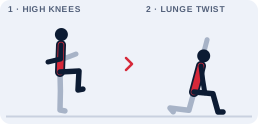
  2. Jog, then high knees, then heel flicks.
  3. Side shuffles facing both ways, then skips with arm circles.
  4. Walking lunges with a twist, leg swings (forwards and sideways), then two build-up runs to 70% speed.

Coaching points

  • Start easy and build up.
  • Stay light on your feet.
  • Never stretch cold – move first.

How much, by age

  • 5–85 min, make it a game ('follow the leader')
  • 9–116–8 min
  • 12–148–10 min
  • 15+10 min, finish with 2–3 sprints
EasierFewer moves, walking pace.
HarderAdd bounding and quick-feet drills at the end.
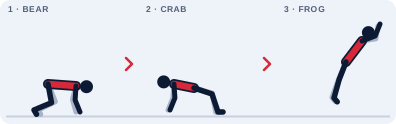
Illustration showing how to do animal moves
Movement skills

Animal moves

5–89–11

Bear crawls, crab walks and frog jumps. Strength, coordination and lots of fun.

8 minSolo or group
Equipment
  • Cones or markers Shoes, water bottles, tins, plastic cups or rolled-up socks
How to do it

Steps

  1. Mark out a short distance – about 5 big steps.
  2. Bear crawl: hands and feet on the floor, knees just off the ground, move opposite hand and foot.
  3. Crab walk: sit, hands behind, lift your bum and walk backwards.
  4. Frog jumps: squat low, hands down, then jump forwards and land softly.

Coaching points

  • Keep your back flat in the bear crawl.
  • Land quietly in frog jumps.
  • Make animal noises if you want – it helps!

How much, by age

  • 5–82 rounds of each animal
  • 9–113 rounds, timed races
EasierShorter distances.
HarderRace a partner, or carry a ball on your back in the bear crawl.
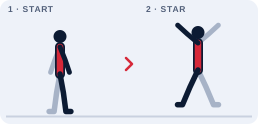
Illustration showing how to do star jumps
Coordination & fitness

Star jumps

5–89–1112–14

A simple full-body move to raise the heart rate and practise rhythm.

3 minSolo
EquipmentNone needed — just space to move.
How to do it

Steps

  1. Stand tall with feet together and arms by your sides.
  2. Jump and land with feet wide while lifting your arms overhead.
  3. Jump back to the start.
  4. Keep a steady rhythm.

Coaching points

  • Land on the balls of your feet.
  • Soft knees.
  • Breathe steadily.

How much, by age

  • 5–83 × 15
  • 9–113 × 20
  • 12–143 × 30 s
EasierStep out instead of jumping.
HarderAdd a squat between each jump.
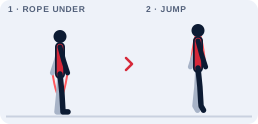
Illustration showing how to do skipping
Footwork & fitness

Skipping

5–89–1112–1415+

One of the best ways to build light, fast feet and fitness.

5–10 minSolo
Equipment
  • Skipping rope Any rope or washing line cut to length, or skip with an imaginary rope
How to do it

Steps

  1. Hold the handles at hip height, rope behind you.
  2. Turn the rope with your wrists, not your arms.
  3. Jump just high enough to clear the rope, landing on the balls of your feet.
  4. Progress: two feet, then alternate feet like jogging, then single leg.

Coaching points

  • Small jumps – about 2–3 cm off the ground.
  • Elbows close to the body.
  • Relax your shoulders.

How much, by age

  • 5–85 × 20 s
  • 9–115 × 30 s
  • 12–146 × 45 s
  • 15+8 × 60 s, mixing patterns
EasierTurn the rope and step over it, or skip with no rope.
HarderDouble-unders or single-leg skips.
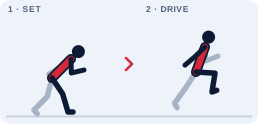
Illustration showing how to do reaction sprints
Speed

Reaction sprints

5–89–1112–1415+

Short, sharp sprints from different starting positions on a signal. Football speed is reaction speed.

10 minPairs or group
Equipment
  • Cones or markers Shoes, water bottles, tins, plastic cups or rolled-up socks
How to do it

Steps

  1. Set a start line and a finish marker 5–10 steps away.
  2. Start in a different position each time: standing, lying on your front, sitting, kneeling.
  3. A partner claps or calls 'Go!' and you sprint to the marker.
  4. Walk back slowly – full recovery between sprints.

Coaching points

  • Drive your arms.
  • Lean forwards for the first few steps.
  • Full effort, full rest.

How much, by age

  • 5–86 sprints as a chase game
  • 9–116–8 × 5–10 m
  • 12–148 × 10 m
  • 15+8–10 × 10–15 m, rest 45–60 s
EasierShorter distance.
HarderChase a partner who starts one step ahead.
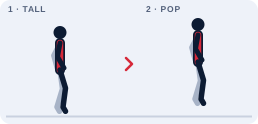
Illustration showing how to do pogo hops (plyometrics)
Speed & power

Pogo hops (plyometrics)

9–1112–1415+

Quick, springy ankle hops. Builds stiffness in the lower leg for faster running. From our 'warm-up: plyometrics' reel.

5 minSolo
EquipmentNone needed — just space to move.
How to do it

Steps

  1. Stand tall, feet hip-width, on the balls of your feet.
  2. Hop up and down quickly using mostly your ankles.
  3. Keep your knees almost straight and spend as little time on the ground as possible.
  4. Progress to forwards–backwards and side-to-side hops.

Coaching points

  • Quick and quiet.
  • Stay tall – don't sink into your knees.
  • Stop the set when the quality drops.

How much, by age

  • 9–113 × 10 hops
  • 12–143 × 15 hops
  • 15+4 × 20 hops, add single-leg
EasierDo slow calf raises first.
HarderSingle-leg pogos, or hop over a line.

Safety: If your knees or heels ache during a growth spurt, reduce jumping and speak to a health professional.

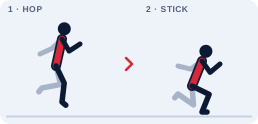
Illustration showing how to do hop and stick
Injury prevention

Hop and stick

5–89–1112–1415+

Learn to land safely. One of the most important injury-prevention habits for footballers.

5 minSolo
EquipmentNone needed — just space to move.
How to do it

Steps

  1. Stand on one leg.
  2. Hop forwards a short distance.
  3. Land on the same leg and 'stick' it – hold still for 3 seconds.
  4. Knee stays in line with your toes, not falling inwards.

Coaching points

  • Land softly, bending at hip and knee.
  • Knee over toes.
  • Hold the landing before the next hop.

How much, by age

  • 5–8Two-footed version: 2 × 5
  • 9–112 × 5 each leg
  • 12–143 × 6 each leg
  • 15+3 × 6 each leg, add sideways hops
EasierJump and land on two feet.
HarderHop sideways, or hop onto a line at an angle.
Illustration showing how to do w-drill (shuffle & backpedal)
Agility

W-drill (shuffle & backpedal)

9–1112–1415+

Shuffle forwards diagonally, backpedal back. Footwork for defending and pressing.

10 minSolo
Equipment
  • Cones or markers Shoes, water bottles, tins, plastic cups or rolled-up socks
How to do it

Steps

  1. Set 5 markers in a zig-zag 'W' shape, 4–5 steps apart.
  2. Sprint or shuffle diagonally forwards to the first marker.
  3. Backpedal diagonally to the next marker.
  4. Continue through the W, then jog back.

Coaching points

  • Stay low with short steps.
  • Turn your hips, not just your feet.
  • Touch each marker with your hand.

How much, by age

  • 9–114 runs
  • 12–146 runs
  • 15+6–8 runs, rest 45 s
EasierWalk the pattern.
HarderFinish with a sprint, or add a ball at the end.
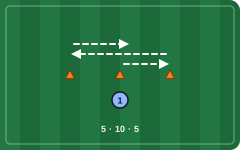
Illustration showing how to do 5-10-5 shuttle
Agility

5-10-5 shuttle

9–1112–1415+

A classic change-of-direction test and drill.

10 minSolo
Equipment
  • Cones or markers Shoes, water bottles, tins, plastic cups or rolled-up socks
How to do it

Steps

  1. Set 3 markers in a line, 5 steps apart. Start at the middle one.
  2. Sprint 5 steps to the right marker and touch the line.
  3. Sprint 10 steps to the far left marker and touch it.
  4. Sprint back through the middle marker. Time yourself.

Coaching points

  • Plant your outside foot to turn.
  • Stay low through the turn.
  • Push off hard.

How much, by age

  • 9–114 runs
  • 12–146 runs
  • 15+6 runs, record your best time
EasierWalk through the turns.
HarderStart facing away and react to a call of 'left' or 'right'.
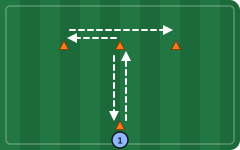
Illustration showing how to do t-drill
Agility

T-drill

12–1415+

Sprint, shuffle and backpedal around a T. Tests every movement direction.

10 minSolo
Equipment
  • Cones or markers Shoes, water bottles, tins, plastic cups or rolled-up socks
How to do it

Steps

  1. Set markers in a T: start marker, one 10 steps forward, and one 5 steps either side of it.
  2. Sprint forward to the middle marker.
  3. Shuffle left to touch the left marker, shuffle right to touch the right one, shuffle back to the middle.
  4. Backpedal to the start.

Coaching points

  • Face forward the whole time.
  • Don't cross your feet when shuffling.
  • Stay low.

How much, by age

  • 12–144 runs
  • 15+6 runs, rest 60 s
EasierSmaller T.
HarderTime it and try to beat your record.
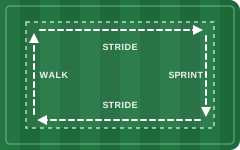
Illustration showing how to do football fartlek
Endurance

Football fartlek

12–1415+

Mix jogging, striding and sprinting like a real match.

15–20 minSolo
Equipment
  • Pitch or park Any open space; use trees or lamp-posts as markers
How to do it

Steps

  1. Jog around the outside of a pitch or park.
  2. On the long sides, stride out at about 70%.
  3. On one short side, sprint. On the other, walk to recover.
  4. Keep going for the set time.

Coaching points

  • Run tall and relaxed.
  • The sprint is a real sprint.
  • Keep the walk short.

How much, by age

  • 12–1412 min
  • 15+15–20 min
EasierSwap the sprint for a stride.
HarderAdd a second sprint section.
Illustration showing how to do box-to-box intervals
Endurance

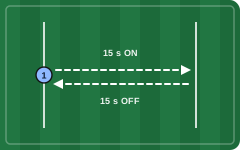
Box-to-box intervals

12–1415+

High-intensity runs with short rests. Builds match fitness for older players.

15 minSolo or group
Equipment
  • Cones or markers Shoes, water bottles, tins, plastic cups or rolled-up socks
How to do it

Steps

  1. Set two lines about 30–40 steps apart.
  2. Run from one line to the other at about 85% effort (15 seconds).
  3. Rest for 15 seconds, then run back.
  4. Complete the set, rest 2–3 minutes, then repeat.

Coaching points

  • Consistent pace for every run.
  • Breathe through the rest.
  • Older players only – younger players get fitter through games.

How much, by age

  • 12–141–2 sets of 6 runs
  • 15+2–3 sets of 8 runs
EasierRest 30 s between runs.
HarderDribble a ball for half the runs.
Illustration showing how to do single-leg balance & touches
Balance

Single-leg balance & touches

5–89–1112–14

Balance on one leg while tapping the ball with the other. Better balance = better touch.

5 minSolo
Equipment
  • Football Any ball
How to do it

Steps

  1. Stand on one leg next to the ball.
  2. Tap the top of the ball with your free foot without putting it down.
  3. Count 10 taps, then switch legs.
  4. Progress to closing your eyes while balancing (no ball).

Coaching points

  • Stand tall.
  • Slight bend in the standing knee.
  • Look at a fixed point.

How much, by age

  • 5–82 × 5 taps each leg
  • 9–113 × 10 each leg
  • 12–143 × 15 each leg on a cushion
EasierHold a wall.
HarderStand on a folded towel or cushion.
Illustration showing how to do hip mobility flow
Mobility

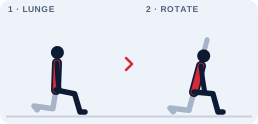
Hip mobility flow

12–1415+

Open up the hips and upper back. Good after school or before bed.

8 minSolo
Equipment
  • Mat (optional) A towel, rug or soft grass
How to do it

Steps

  1. Step into a long lunge.
  2. Place the opposite hand on the floor and rotate, reaching the other arm to the sky.
  3. Hold 2 seconds, return, then switch sides.
  4. Finish with a hip flexor stretch and a calf stretch.

Coaching points

  • Move slowly.
  • Breathe out as you rotate.
  • No bouncing.

How much, by age

  • 12–142 rounds, 5 each side
  • 15+2–3 rounds, 5 each side
EasierKeep the back knee on the floor.
HarderAdd a hamstring rock-back between each side.
Illustration showing how to do cool-down stretches
Recovery

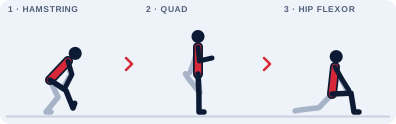
Cool-down stretches

5–89–1112–1415+

Gentle stretches after training or matches to help you feel ready for the next one.

8 minSolo
Equipment
  • Mat (optional) A towel, rug or soft grass
  • Wall Any solid wall or fence
How to do it

Steps

  1. Walk for 2 minutes to bring your breathing down.
  2. Hamstring stretch: heel forward, toes up, hinge from the hips.
  3. Quad stretch: hold your foot behind you, knees together.
  4. Hip flexor stretch: kneel in a lunge and push the hips forward gently.

Coaching points

  • Hold each stretch, don't bounce.
  • Mild stretch only – never pain.
  • Drink water afterwards.

How much, by age

  • 5–8Each stretch 10 s, make it a game
  • 9–1120 s each side
  • 12–1420–30 s each side
  • 15+30 s each side
EasierHold a wall for balance.
HarderAdd a calf stretch and a groin stretch.
Illustration showing how to do injury-prevention routine
Injury prevention

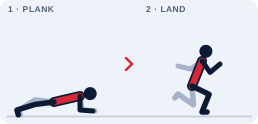
Injury-prevention routine

9–1112–1415+

Inspired by FIFA 11+ (and 11+ Kids for under-14s): planks, balance and landing work done regularly.

10–15 minSolo or team
Equipment
  • Mat (optional) A towel, rug or soft grass
How to do it

Steps

  1. Run through a short dynamic warm-up.
  2. Plank and side plank.
  3. Single-leg balance and hop-and-stick landings.
  4. Squats and, for older players, Nordic hamstring lowers.

Coaching points

  • Consistency matters most – twice a week or more.
  • Quality first: good knee position.
  • Fits as a warm-up before training.

How much, by age

  • 9–112× per week, 10 min
  • 12–142–3× per week, 12 min
  • 15+2–3× per week, 15 min
EasierShorter holds and fewer hops.
HarderLonger holds and add partner pushes in balance.
Illustration showing how to do sprint technique drills
Speed

Sprint technique drills

9–1112–1415+

A-march, A-skip and fast-arm drills to run more efficiently.

10 minSolo
Equipment
  • Cones or markers Shoes, water bottles, tins, plastic cups or rolled-up socks
How to do it

Steps

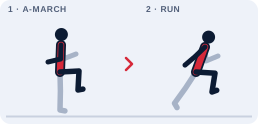
  1. A-march: march forward with a high knee, toes pulled up, opposite arm driving.
  2. A-skip: the same pattern with a skip.
  3. Fast arms: seated, pump the arms quickly from hip to cheek.
  4. Finish with 3 relaxed build-up runs over 20 steps.

Coaching points

  • Tall posture.
  • Foot lands under the hips.
  • Arms drive the legs.

How much, by age

  • 9–112 × 10 steps each drill
  • 12–143 × 15 steps
  • 15+3 × 20 steps + 4 sprints
EasierMarch only.
HarderAdd straight-leg bounds.
Want a plan for your player?

Get personal guidance.

Tell us your player's age and goals and we'll point you to the right sessions.