
Train between sessions. Grow every week.
82 illustrated football drills, fitness sessions and strength workouts — each one scaled to age, with clear doses and swaps for when you don't have the kit.
Four ways to train.
Filter every page by age, focus or search. Open a card to see steps, coaching points and how much to do.
Football drills
Ball mastery, dribbling, passing, turning, shooting, defending and small games — with pitch diagrams.
Open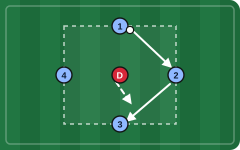
Fitness & speed
Warm-ups, speed, agility, endurance, mobility, cool-downs and injury prevention.
Open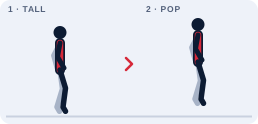
Bodyweight strength
Squats, lunges, bridges, planks, push-ups, Nordics and Copenhagens.
Open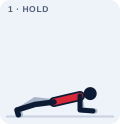
Light weights
Goblet squats, RDLs, rows, presses and carries for players aged 12+.
Open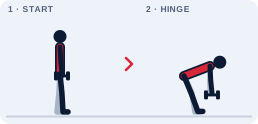
The right work at the right age.
Children aren't mini adults. Here's what a good week can look like at each stage. Pick your player's age on any page and we'll highlight the right dose.
Foundation · Play is the plan
- 60 minutes of active play every day, across the week
- 2–4 short ball sessions (10–15 min) at home
- Animal moves, games and lots of touches
- Bodyweight only — keep it fun
Development · Build the skills
- 3 home sessions a week of 15–20 min
- Ball mastery every time, plus one new skill
- Short bodyweight circuits twice a week
- Learn to land: hop-and-stick
Youth · Strong foundations
- 3–4 sessions a week of 20–30 min
- Bodyweight strength twice a week
- Introduce very light weights with supervision
- Injury-prevention routine before training
Advanced · Train like a player
- Daily technical work — even 15 minutes
- Strength 2–3 times a week, light weights
- Speed and conditioning 1–2 times a week
- At least one full rest day
Use what's at home.
Every exercise lists an alternative to the equipment. Here are the most useful swaps.
| Instead of | Use |
|---|---|
| Cones / markers | Shoes, water bottles, tins, plastic cups, rolled-up socks, T-shirts |
| Goal | Two bags or jumpers as posts, a chalk square on a safe wall, a bin to hit |
| Agility ladder | Chalk lines, tape on a hard floor, sticks laid in a row |
| Mini hurdles | A pool noodle across two shoes, rolled towels, a line to jump |
| Rebounder | A safe wall you have permission to use, a garage door, a partner |
| Bibs | Different coloured T-shirts |
| Dumbbells | Filled water bottles (1–2 kg), bags of rice or flour, a backpack with a few books |
| Kettlebell | A full water bottle or a bag of rice hugged to the chest |
| Medicine ball | A football or basketball (pass it — don't slam a football) |
| Resistance band | An old pair of tights tied in a loop — or no band |
| Bench or box | The bottom stair, a sofa edge, a sturdy chair against a wall |
| Skipping rope | Any rope, or skip with an imaginary rope |
The academy notebook.
Simple guides for getting ready, supporting your player and making the most of every session.
Your first-session checklist
- Confirm the venue, start time and suitable footwear with the academy.
- Bring a filled water bottle, shin pads and comfortable sports clothing.
- Pack a light waterproof layer for outdoor sessions.
- Arrive with time to meet the coach and get familiar with the space.
- Tell the coaching team about any support your player needs before the session.
Supporting your player
- Ask “What did you enjoy?” before asking about the result.
- Praise effort, teamwork and trying something new.
- Give players space to make mistakes and work things out.
- Let the coach guide the session and save questions for an appropriate moment.
- Keep football one positive part of a balanced week.
Reflecting after a session
Three questions turn a session into a learning moment:
- What felt good today?
- What was challenging?
- What is one thing you would like to try next time?
No need for a long report — a short conversation is enough.
Rest, sleep and growth spurts
- Sleep is when players recover and grow — aim for a consistent bedtime.
- Plan at least one full rest day each week.
- During growth spurts, knees and heels can ache. Reduce jumping and sprinting and speak to a health professional if pain continues.
Academy information & policies
Session timetables, the player code of conduct and academy policies will be added once confirmed. Contact the academy before attending to check current arrangements.
Ask the coach.
Not sure where to start? Tell us your player's age and goals.