A love for the game. A place to grow. Free home training hub →
Training hub · Strength

Light weights for 12+.

A next step for older players who have mastered bodyweight technique. Household swaps included — water bottles, bags and backpacks work.

Age
Focus

Light weights are for players aged 12 and over. Learn every movement with bodyweight first, ideally with a coach or qualified adult watching. Choose a load you could lift 2–3 more times with perfect form, train 2–3 times a week on non-consecutive days, and never max out. Stop if anything hurts.
Illustration showing how to do goblet squat
Legs

Goblet squat

12–1415+

The best first loaded squat. The weight at your chest helps you stay upright.

8 minSolo
Equipment
  • Light dumbbell or kettlebell A full water bottle, a bag of rice held at the chest, or a backpack hugged to your chest
How to do it

Steps

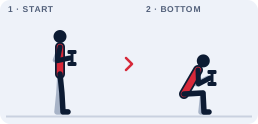
  1. Hold the weight close to your chest with both hands.
  2. Feet shoulder-width, toes slightly out.
  3. Squat down between your knees, elbows inside the knees.
  4. Stand up tall.

Coaching points

  • Chest up, weight close.
  • Heels down.
  • Same technique as a bodyweight squat.

How much, by age

  • 12–142 × 10–12, very light, supervised
  • 15+3 × 8–12, add load gradually
EasierBodyweight squat.
HarderPause at the bottom.
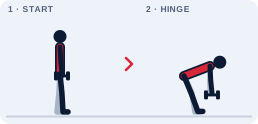
Illustration showing how to do romanian deadlift
Hamstrings & glutes

Romanian deadlift

12–1415+

Teaches a strong hip hinge and builds the hamstrings that power sprinting.

8 minSolo
Equipment
  • Two light dumbbells Two filled water bottles, two shopping bags with tins, or two bags of rice
How to do it

Steps

  1. Stand holding weights in front of your thighs, soft knees.
  2. Push your hips back and slide the weights down your legs.
  3. Stop when you feel a stretch in your hamstrings, back flat.
  4. Squeeze your bum to stand tall.

Coaching points

  • Back flat throughout.
  • Weights stay close to your legs.
  • Hips move back, not down.

How much, by age

  • 12–142 × 10, broomstick or very light
  • 15+3 × 8–10
EasierPractise with a broomstick along your back.
HarderSingle-leg version.
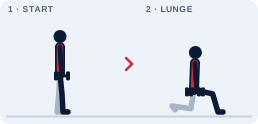
Illustration showing how to do reverse lunge with weights
Legs

Reverse lunge with weights

12–1415+

Add light weights to a lunge once you can do 12 good bodyweight reps.

8 minSolo
Equipment
  • Two light dumbbells Two filled water bottles, two shopping bags with tins, or two bags of rice
How to do it

Steps

  1. Hold a weight in each hand by your sides.
  2. Step back into a lunge.
  3. Lower until the back knee nearly touches the floor.
  4. Drive back up through the front foot.

Coaching points

  • Tall posture.
  • Front knee tracks the toes.
  • Control every rep.

How much, by age

  • 12–142 × 8 each leg, light
  • 15+3 × 8–10 each leg
EasierBodyweight lunge.
HarderWalking lunges.
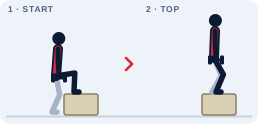
Illustration showing how to do step-up with weights
Legs

Step-up with weights

12–1415+

Loaded single-leg strength – very specific to running and jumping.

8 minSolo
Equipment
  • Two light dumbbells Two filled water bottles, two shopping bags with tins, or two bags of rice
  • Low step or box The bottom stair, a sturdy low bench or a kerb – never anything that can tip or slide
How to do it

Steps

  1. Hold light weights by your sides.
  2. Place one foot on the step.
  3. Drive up to stand on the step.
  4. Step down slowly.

Coaching points

  • Use the top leg only.
  • Stable step only.
  • Knee in line.

How much, by age

  • 12–142 × 8 each leg
  • 15+3 × 8–10 each leg
EasierNo weight.
HarderHigher step (knee no higher than hip).
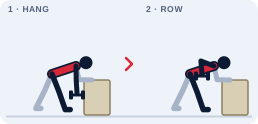
Illustration showing how to do single-arm row
Upper back

Single-arm row

12–1415+

Strong upper back for posture, shielding and holding off opponents.

6 minSolo
Equipment
  • Light dumbbell A filled water bottle (1–2 kg), a bag of rice or flour, or a backpack with a few books
  • Bench A sofa edge, a sturdy chair against a wall, or the bottom stair
How to do it

Steps

  1. One hand on a bench or sofa, feet apart, back flat.
  2. Let the weight hang below your shoulder.
  3. Pull your elbow back towards your hip.
  4. Lower slowly and switch sides.

Coaching points

  • Back flat, don't twist.
  • Squeeze the shoulder blade.
  • Slow on the way down.

How much, by age

  • 12–142 × 10 each arm
  • 15+3 × 10–12 each arm
EasierLighter weight.
Harder3-second lowering.
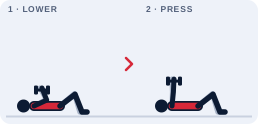
Illustration showing how to do floor press
Upper body

Floor press

12–1415+

A safe pressing exercise – the floor limits the range for the shoulders.

6 minSolo
Equipment
  • Two light dumbbells Two filled water bottles, two shopping bags with tins, or two bags of rice
  • Mat (optional) A towel, rug or soft grass
How to do it

Steps

  1. Lie on your back, knees bent, holding weights above your chest.
  2. Lower until your upper arms touch the floor.
  3. Press back up to straight arms.
  4. Keep the weights over your chest.

Coaching points

  • Elbows at about 45°.
  • Wrists straight.
  • Control the lowering.

How much, by age

  • 12–142 × 10, light
  • 15+3 × 8–12
EasierPush-ups.
HarderOne arm at a time.
Illustration showing how to do half-kneeling press
Shoulders & core

Half-kneeling press

12–1415+

Shoulder strength with built-in core and hip stability.

6 minSolo
Equipment
  • Light dumbbell A filled water bottle (1–2 kg), a bag of rice or flour, or a backpack with a few books
How to do it

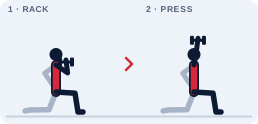
Steps

  1. Kneel on one knee, other foot forward.
  2. Hold a weight at shoulder height on the side of the down knee.
  3. Press it overhead without leaning.
  4. Lower slowly. Switch sides.

Coaching points

  • Squeeze the glute of the down knee.
  • Ribs down.
  • Press straight up.

How much, by age

  • 12–142 × 8 each side
  • 15+3 × 8–10 each side
EasierLighter weight, or standing.
HarderPause at the top.
Illustration showing how to do farmer's carry
Grip & core

Farmer's carry

12–1415+

Walk tall holding weights. Builds grip, core and posture.

5 minSolo
Equipment
  • Two light dumbbells Two filled water bottles, two shopping bags with tins, or two bags of rice
How to do it

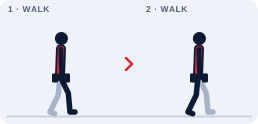
Steps

  1. Pick up a weight in each hand (bend the knees, not the back).
  2. Stand tall with shoulders back.
  3. Walk 15–20 steps with short, controlled steps.
  4. Put down safely, rest and repeat.

Coaching points

  • Stay tall – don't lean.
  • Shoulders down and back.
  • Tight core.

How much, by age

  • 12–143 × 15 steps, light
  • 15+3–4 × 20 steps
EasierOne weight (suitcase carry).
HarderHeavier, or carry in one hand only.
Illustration showing how to do weighted calf raise
Lower legs

Weighted calf raise

12–1415+

Add light load to calf raises for faster, more powerful running.

4 minSolo
Equipment
  • Light dumbbell A filled water bottle (1–2 kg), a bag of rice or flour, or a backpack with a few books
  • Low step or box The bottom stair, a sturdy low bench or a kerb – never anything that can tip or slide
How to do it

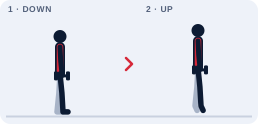
Steps

  1. Hold a weight in one hand, the other hand on a wall.
  2. Rise up onto your toes.
  3. Pause.
  4. Lower slowly, below level if on a step.

Coaching points

  • Slow lowering.
  • Full range.
  • Over the big toe.

How much, by age

  • 12–142 × 12
  • 15+3 × 12–15, or single-leg
EasierBodyweight.
HarderSingle-leg on a step.
Illustration showing how to do hip thrust
Glutes

Hip thrust

15+

Builds strong glutes for sprinting and resisting challenges.

6 minSolo
Equipment
  • Light dumbbell A filled water bottle (1–2 kg), a bag of rice or flour, or a backpack with a few books
  • Bench A sofa edge, a sturdy chair against a wall, or the bottom stair
How to do it

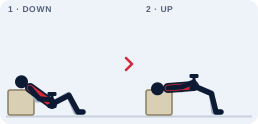
Steps

  1. Sit with your upper back against a sofa or bench, weight on your hips.
  2. Feet flat, knees bent.
  3. Drive your hips up until your body is straight from shoulders to knees.
  4. Lower with control.

Coaching points

  • Chin tucked.
  • Push through heels.
  • Squeeze at the top.

How much, by age

  • 15+3 × 10–12
EasierGlute bridge on the floor.
HarderSingle-leg hip thrust.
Illustration showing how to do wall chest pass
Upper-body power

Wall chest pass

12–1415+

Fast, explosive pushes. Good for upper-body power and getting up quicker.

5 minSolo
Equipment
  • Medicine ball (light) A football or basketball – pass it, never slam a football
  • Wall Any solid wall or fence
How to do it

Steps

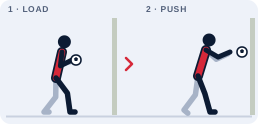
  1. Stand about 2 steps from a wall in an athletic stance.
  2. Hold the ball at your chest.
  3. Step and push the ball powerfully into the wall.
  4. Catch the rebound and repeat.

Coaching points

  • Fast push, fully extend the arms.
  • Stay balanced.
  • Catch with soft hands.

How much, by age

  • 12–143 × 8
  • 15+3 × 10, mix in rotational throws
EasierLighter ball, closer to the wall.
HarderRotational side throws.
Illustration showing how to do mini-band side walk
Hips

Mini-band side walk

9–1112–1415+

Wakes up the hip muscles that keep your knees stable when landing and cutting.

4 minSolo
Equipment
  • Mini resistance band An old pair of tights tied in a loop, or do it without a band
How to do it

Steps

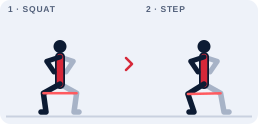
  1. Put a light band around your knees (or just above the ankles).
  2. Get into a quarter-squat.
  3. Step sideways, keeping tension in the band.
  4. Step back the other way.

Coaching points

  • Stay low.
  • Toes forward.
  • Don't let the knees cave in.

How much, by age

  • 9–112 × 8 steps each way (no band)
  • 12–143 × 10 steps each way
  • 15+3 × 12 steps each way
EasierNo band.
HarderBand around the ankles.
Want a plan for your player?

Get personal guidance.

Tell us your player's age and goals and we'll point you to the right sessions.